{{ variable.name }} : {{ variable.values[selectedVariantsIndex[variable_index]].name }}
cantidad:
Cantidad mínima de pedido: {{ product.min_quantity }} uds
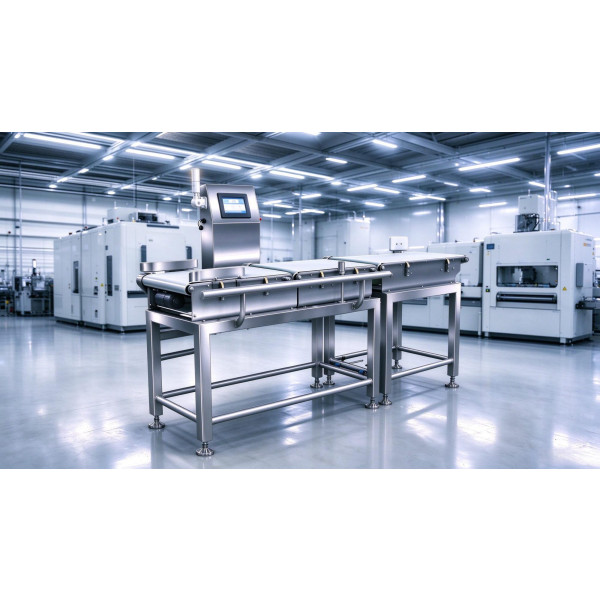
The XRDJ-500 is a heavy duty carton checkweigher built for cases, bags and totes weighing up to 40 kg. Large packages are unforgiving on an inline scale: their weight makes inertia and vibration significant, and their size makes missing-item detection the primary quality risk. This machine uses a reinforced frame and a high-force reject mechanism to handle both.
| Weighing range | 0.5 kg – 40 kg (customised) |
|---|---|
| Dynamic accuracy | ±1 g – ±15 g |
| Maximum speed | 20 – 50 pcs/min |
| Overall dimensions | 5000 × 1732 × 1020 mm |
| Frame material | Reinforced SUS304 stainless steel |
| Reject method | High-force push rod (air blast not suitable at this weight) |
| Display | 10-inch industrial touchscreen |
| Product recipes | Up to 200 groups |
Rollers or a heavy-duty belt carry the case through the weighing zone. A high-capacity load cell measures the package while it is moving, and digital filtering plus multi-stage damping remove the vibration transmitted by upstream equipment such as bag-sewing and cartoning machines. The measured weight is checked against the recipe window, and a high-force rod pushes rejects off the line into a locked bin.
Products handled by this heavy duty checkweigher include rice and flour bags, animal feed and fertilizer sacks, chemical raw material bags, whole carton cases, plastic drums, buckets, large parcels and industrial packaged materials. It is also used for missing-item inspection, counting components inside a case, and confirming that a case contains the full complement of units.
You cannot run a 30 kg bag on a machine built for 500 g sachets. The frame deflects, the accuracy drifts, the reject mechanism lacks the force to move the product, and the system generates false alarms all shift long. Three things change on a heavy duty checkweigher: the frame is thickened and reinforced, the weighing platform is sized so the whole package sits on it without straddling two sections, and the reject uses a high-force push rod rather than an air blast. Using a light-duty machine for heavy bags is the single most common cause of unstable heavy-package weighing.
When quoting a carton checkweigher, prepare the following so the supplier can select the right platform: the heaviest product weight in kg, the case dimensions in mm, the required output in cases per hour, the existing line height, the reject direction, and the production environment. Products with irregular shapes or high impact during transfer need a platform and conveyor customised around the actual sample rather than a standard model.
The airflow needed to move a 40 kg case would require an impractically large compressor and would fail to move the case consistently. A high-force push rod is far more reliable at this weight.
Yes. When the target weight is set to the full case weight, a case missing units falls below the lower limit and is rejected automatically.
Expect ±1 g at the low end of the range and around ±15 g at 40 kg. Dynamic accuracy always depends on product behaviour on the belt, so testing with real samples before final selection is recommended.